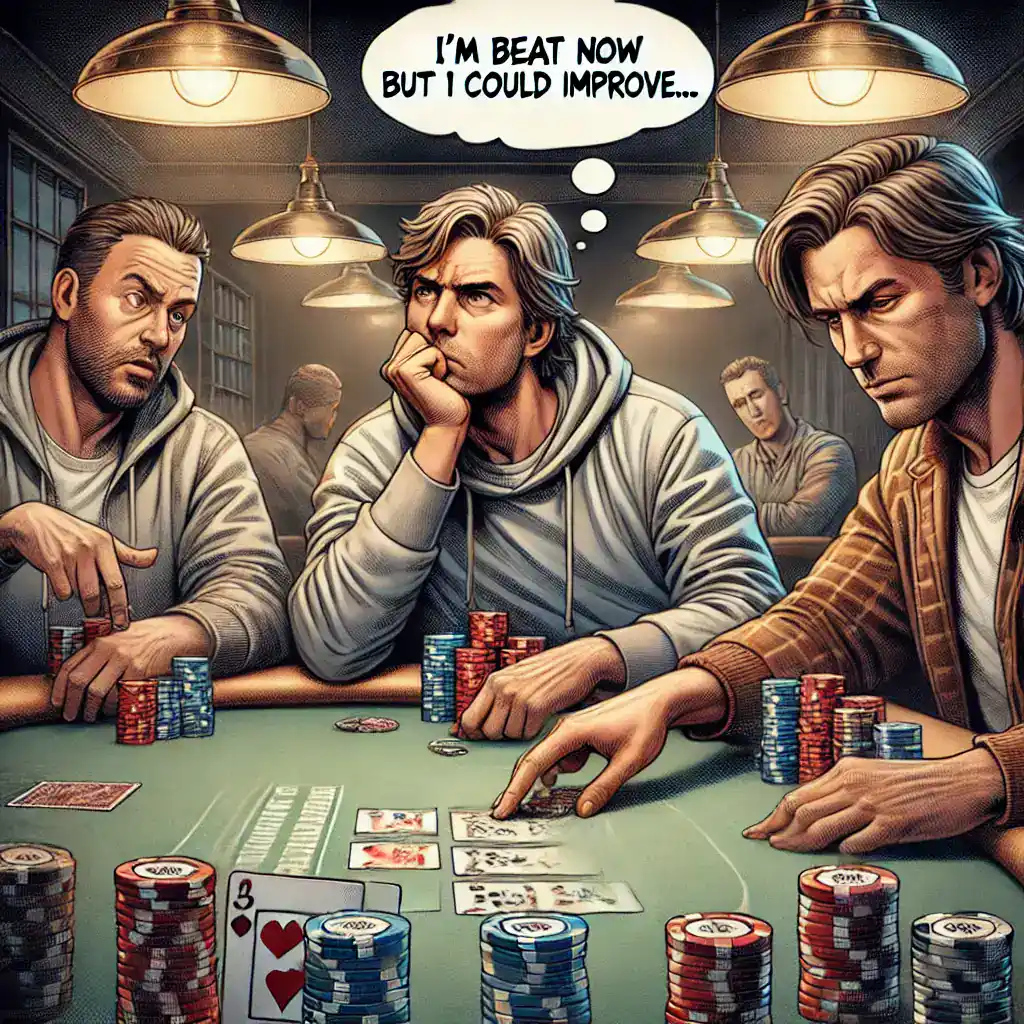
An In-Depth Critique of a Costly Poker Hand: Learning from Hero’s Mistakes
In the world of low-stakes poker, it’s often said that the biggest leaks aren’t in how much we win, but in how much we lose. Every poker hand offers a lesson, particularly those that cost us a hefty portion of our stack. Today, we’re dissecting a hand that caught my eye from a popular YouTube vlogger, tilted from previous losses, he makes several critical errors that lead to losing a massive pot. Understanding these mistakes is crucial to improving as a player, especially in low-stakes games where solid fundamentals often lead to profitability.
The Hand Breakdown
Our hero ($440 effective) is UTG+1 in a $1/$3 game. He opens to $10 with the 6♦4♦ (somewhat tilted from the last few hands). The player in MP ($276 eff) raises to $40, and the button ($460 eff) calls. The blinds fold and the hero decides to make the call.
The flop is Q♥9♦10♦, Hero checks his low flush draw, then the MP player immediately goes all-in for his remaining $230. The button player then re-ships for his remaining $420.
When it gets back to the hero he goes through his thought process in the video and finally decides to call with the flush draw assuming that if a diamond comes he will be good. He rationalizes the call thinking he has enough equity to make the call profitable in the long run.
The turn is K♠ river is 3♠, MP has K♥K♦ and the button has 9♣9♠ and the Hero torches $460 in a situation he did not need to get involved in.
Mistake #1: Opening with 6♦4♦ from UTG+1
Starting with our Hero’s first decision, choosing to open-raise to $10 with 6♦4♦ from UTG+1 is a significant error. Low-stakes poker is often about playing tight and aggressive, especially from early positions. In a $1/$3 game, ranges from early positions should typically consist of stronger hands. The 6♦4♦, while it has some suited-connecter appeal, is far too weak to justify an open from UTG+1.
Opening with a hand like this can be especially problematic because:
- Positional Disadvantage: UTG+1 is one of the earliest positions at the table, meaning there are many players yet to act. The likelihood of facing resistance (a call or a raise) is higher, making it difficult to play a speculative hand like 6♦4♦ profitably.
- Tilt Factor: The Hero’s decision to open with such a marginal hand seems to be influenced by tilt. When emotions drive decisions, the quality of play often declines, leading to costly mistakes.
Better Play: Fold this hand preflop. Save those chips for when you have a more solid hand, particularly when playing out of position.
Mistake #2: Calling the 3-Bet
Once the MP player 3-bets to $40 and the Button calls, the Hero faces a decision. Unfortunately, calling the 3-bet is another significant mistake.
Why this is a Mistake:
- Bad Pot Odds: The Hero is being asked to call $30 more into a pot that will become $126. While the odds seem appealing, the Hero’s hand isn’t strong enough to continue, especially given the likelihood that one or both opponents have stronger holdings.
- Opponents 3-bet range: 3-bets in low-stakes games are not common, this means when a recreational player 3-bets you need to respect it or pay the price
- Implied Odds Aren’t Enough: Even if the Hero flops a draw or a pair, it’s not guaranteed that they’ll be able to realize the full value of their hand. The potential payout doesn’t justify the risk, especially against opponents with stronger ranges.
- Stack-to-Pot Ratio (SPR): Post-flop, the Hero will be playing with a relatively low SPR, making it difficult to maneuver with a speculative hand like 6♦4♦.
Better Play: Fold to the 3-bet. Without a premium hand or a good reason to believe the opponents are weak, it’s best to conserve your chips.
Mistake #3: Chasing A Low Flush Draw
The flop comes Q♥9♦10♦, giving the Hero a flush draw. This is where the hand starts to spiral out of control.
The All-In from MP:
- The MP player shoves for $230, which is almost a 2x pot bet. This bet shows significant strength, suggesting the MP player has a very strong hand since they arere willing to commit their entire stack.
The Re-Ship from the Button:
- When the Button re-shoves for $420, the Hero should get the message that he is dominated. Unfortunately, the Hero decides to call, which is the most consequential mistake of the hand.
Evaluating the Pot Odds:
- Pot Size Before Hero’s Call: $126 (pre-flop) + $230 (MP shove) + $420 (Button’s re-ship) = $776
- Hero’s Call Amount: $420
The Hero is getting approximately 1.85:1 on a call ($776 in the pot and $420 to call). To determine if this call is correct, we need to consider the Hero’s equity in the hand. The Hero has a flush draw, which usually gives him around 35% equity against a made hand if both opponents have one-pair or an overpair.
However, in this scenario, against two opponents likely holding 2-pair or better, the Hero’s flush draw equity drops significantly. When facing two sets, the Hero’s equity is closer to 18-22%. The worst case scenario is if the Hero is up against a set and a higher flush draw, this would mean the Hero is drawing dead and can not improve. This means that the Hero is not getting the correct odds to call.
Why Calling is a Huge Error:
- Negative Expected Value: The Hero needs at least 35% equity to make this call profitable, but in reality, they are far below that. Even though the pot odds might seem close, the actual equity makes this a -EV (negative expected value) decision.
- Overvaluing the Draw: The Hero is putting all their chips at risk on a draw. In low-stakes games, it’s better to be the one making the bets with strong hands rather than calling off your stack on draws.
Better Play: Fold to the Button’s all-in. With two opponents showing strength, it’s time to let go of the draw and wait for a better spot.
Mistake #4: Not Recognizing Opponents’ Strength
Throughout the hand, the Hero fails to properly assess the strength of their opponents’ actions. Poker is a game of ranges and reading your opponents, and this hand highlights the importance of both.
MP’s 3-Bet: Typically, a 3-bet from middle position, especially in a low-stakes game, indicates a strong hand. This is usually AK, QQ+, or a similar range. The Hero should have recognized that their 6♦4♦ was way behind this range.
Button’s Call of the 3-Bet: When the Button cold-calls the 3-bet, it suggests a strong range as well, likely JJ+, AQ+—hands that can stand up to a 3-bet but aren’t quite strong enough to 4-bet. Occasionally, especially from recreational players, you will run into a premium hand like AA or KK that the rec player is trapping with as well.
Button’s Re-Ship on the Flop: The Button’s shove is a strong indication that they have a made hand or at minimum, a superior draw to the Hero’s. Given the board texture (Q♥9♦10♦), the Hero should have considered that the Button could have a set, two pair, an overpaid, or a big combo draw—all of which are far ahead of the Hero’s flush draw.
Better Play: Pay closer attention to the signals your opponents are giving. Poker is about more than just your hand; it’s about what your opponents are telling you with their actions.
Conclusion: Learning from Hero’s Mistakes
This hand is a textbook example of how a series of small mistakes can culminate in a massive loss. From opening with a weak hand, to calling a 3-bet out of position, to chasing a draw against all odds, the Hero’s decisions led to a significant loss of chips that could have been avoided.
In low-stakes poker, the key to success is often as much about avoiding big losses as it is about making big wins. By tightening up preflop ranges, being mindful of opponents’ actions, and recognizing when to fold, players can avoid the pitfalls that lead to losing big pots like this one.